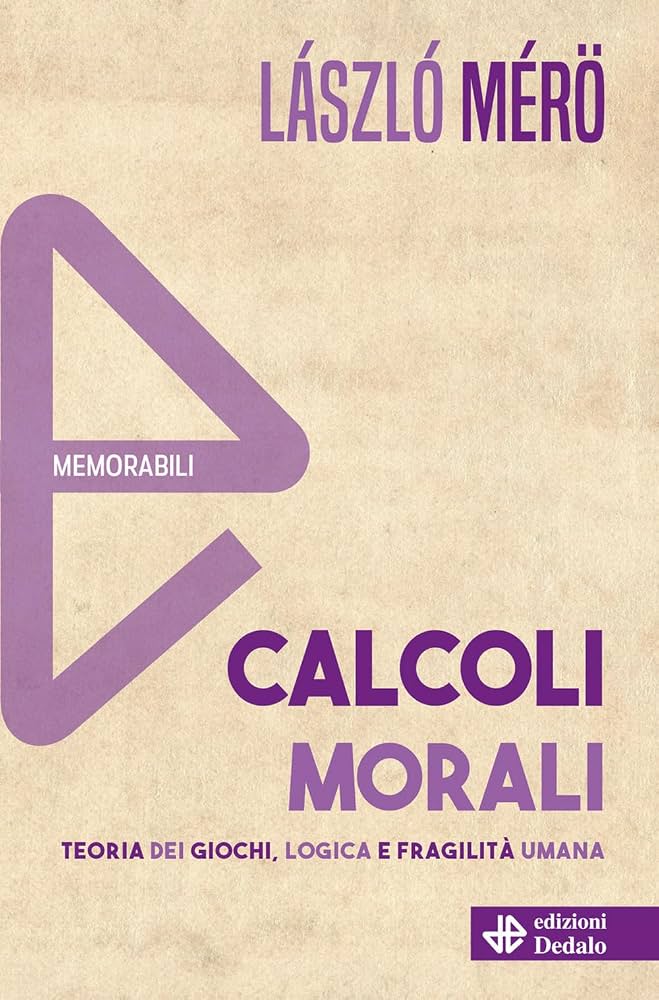
Calcoli morali
Quando tirare un dado è la scelta razionale: László Mérő e la teoria dei giochi
Prefazione
Calcoli morali di Mérő è un titolo molto corposo, che incrocia diverse aree del sapere per distillarle nella teoria dei giochi.
Alcuni risultati sono davvero sorprendenti e si possono cogliere solo tenendo conto della psiche umana.
L'asta per un dollaro
Facciamo un gioco in cui il premio in palio è un dollaro. È un'asta fra due giocatori, con rilancio minimo di un centesimo.
Chi fa l'offerta più alta vince il dollaro, ma tutti i giocatori pagano la loro ultima offerta.
Che gioco strambo, vero?
Potrei offrire un centesimo e poi evitare qualsiasi rilancio. Oppure, se sono il primo a giocare, potrei offrire 0,99 $. E se l'offerta più alta superasse il dollaro, dovrei comunque rilanciare per ridurre la perdita, visto che pagherò in ogni caso?

Il problema del chicken
Prima di approfondire il problema precedente, vediamo un altro gioco.
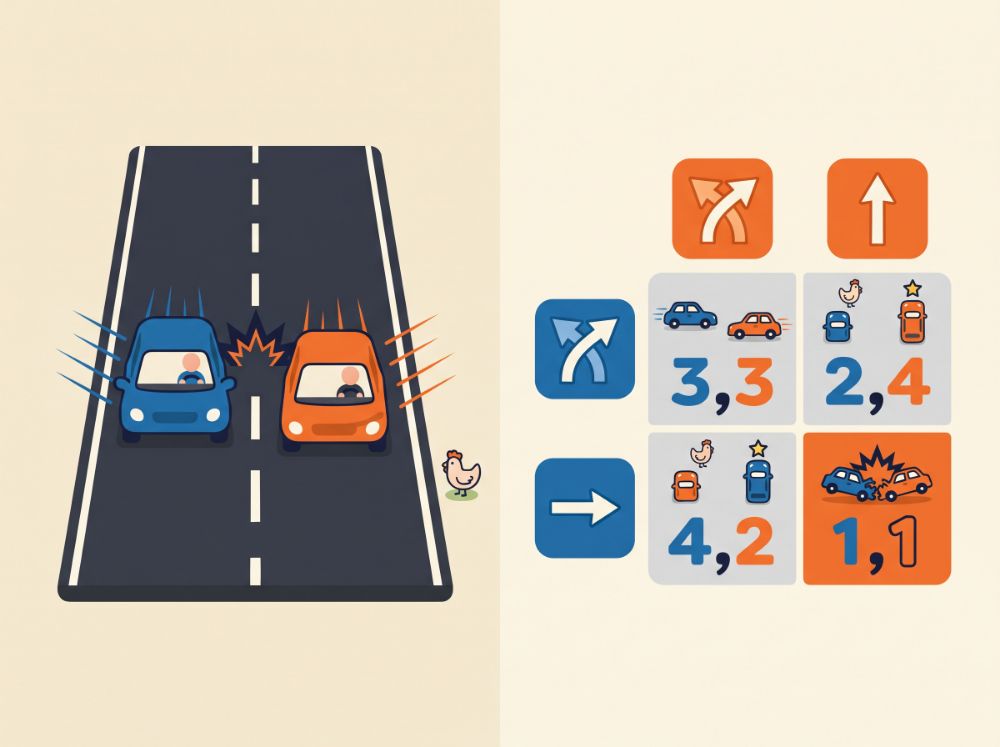
Due automobilisti lanciano le loro auto verso un dirupo. Chi sterza per primo evita di sfracellarsi, ma perde e passa per codardo.
Come conviene comportarsi?
Due giochi non così teorici
L'asta del dollaro e il chicken sono due dilemmi classici della teoria dei giochi.
Per Mérő la corsa agli armamenti nucleari della guerra fredda è un dilemma del prigioniero passo per passo, ma come processo è un'asta del dollaro.
La crisi dei missili di Cuba, invece, fu un chicken.
Del resto, quando si conosce il meccanismo dell'escalation, l'asta del dollaro stessa si avvicina molto al chicken.
La regola d'oro e l'imperativo kantiano (secondo Mérő)
Proviamo a non risolvere gioco per gioco con una strategia dedicata. Cerchiamo invece una regola generale da applicare sempre. Mérő ne propone due.
La regola d'oro ci dice: «non fare agli altri quello che non vorresti fosse fatto a te». Ha un suono quasi evangelico.
Funziona nel dilemma del prigioniero, dove porta entrambi i giocatori a cooperare. Nell'asta del dollaro suggerisce di non giocare: avrete notato che il gioco ha un aspetto capestro.
L'imperativo categorico porta alle stesse conclusioni, ma con un percorso logico diverso. Ci chiede: «E se lo facessero tutti?». Applicato al dilemma del prigioniero, rende conveniente cooperare.
E nel caso dell'asta del dollaro?
I dadi sono così odiosi?
«Ti piacciono i giochi con i dadi?»
«Dipende da come si usano.»
Questa risposta lascia aperta la porta al piazzamento dadi e la chiude completamente al push your luck.
Il lancio del dado, con la sua imprevedibilità, è spesso visto dai giocatori di eurogame come un elemento irrazionale che rovina l'esperienza di gioco.
In Calcoli morali la tesi più forte che Mérő vuole far passare è: talvolta prendere una decisione casuale è l'unica scelta razionale.
Questa affermazione, forse un po' aulica, è la soluzione dell'imperativo categorico all'asta del dollaro.
Affidarsi al caso è la soluzione
Non proprio bendandosi gli occhi, ma a volte decidere con il lancio di un dado è la cosa migliore da fare.
Nell'asta del dollaro, supponiamo di lanciare un dado a 6 facce: da 1 a 3 rilanciamo di un centesimo, da 4 a 6 usciamo.
Una lunga serie di numeri bassi è improbabile, quindi non si arriva al paradosso di offrire più di un dollaro.
Possiamo discutere sulla scelta del 50%: questa è la scelta matematica. La scelta della regola è invece una scelta etica.
Infine, per Mérő, un problema è morale quando tutti lo affrontano con la stessa regola universale, e quindi contano solo gli esiti simmetrici.
L'imperfezione della regola d'oro
Uguali e diversi è una canzone di Gianluca Grignani che dice: «E credo che sian tutti uguali e diversi da me».
È anche la sintesi che si trova nelle ultime pagine di Calcoli morali.
Il punto è che spesso neppure noi sappiamo cosa vogliamo. È presuntuoso ritenere che ciò che per noi è conveniente, buono o desiderabile lo sia anche per gli altri.
Mi verrebbe da dire che questa assunzione non giustificata sia la causa prima di ogni malinteso.
A volte può causare veri e propri disastri, come nella battaglia dei sessi.
La battaglia dei sessi
Marito e moglie usciranno la sera insieme. Non possono sentirsi prima a causa di un blackout telefonico e si vedranno direttamente sul posto.
L'evento è solo un pretesto: lo scopo principale è passare del tempo insieme.
Tuttavia ognuno ha le sue preferenze, note all'altro: il marito vuole andare a una partita di basket, la moglie a un concerto.
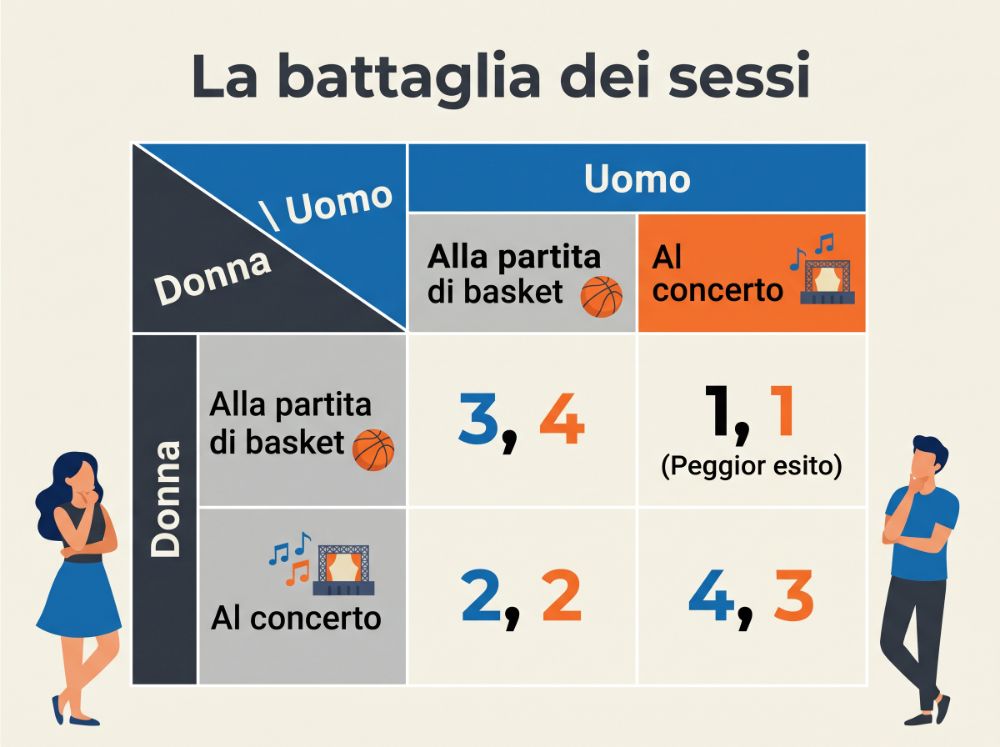
La regola d'oro sfocia in quello che io chiamo «buonismo». Ognuno agisce per il bene dell'altro e tutti e due finiscono nel posto desiderato dal partner, ma da soli.
L'imperativo kantiano, nella sua strategia pura (cioè prima di aggiungere un pizzico di casualità), porta ciascuno all'evento che preferisce. Ma in solitudine.
Ancora una volta la casualità viene in soccorso con le strategie miste.
Ogni giocatore lancia un d8: da 1 a 5 va all'evento che desidera, da 6 a 8 a quello del partner.
La matematica, e se volete la razionalità, riprende in mano la situazione e dimostra che questa strategia è l'opzione migliore.
Si potrebbe obiettare che è un caso teorico, perché è difficile formalizzare una matrice di payoff in termini così netti.
La lezione che si porta a casa è che cercare a tutti i costi di soddisfare l'altro è un comportamento tossico.
Ce lo dice la matematica, almeno in questo gioco.

Fra razionale e irrazionale
Quella che comunemente chiamiamo «scelta razionale» è legata a un calcolo. Ho degli input e delle condizioni al contorno di cui prendo atto. Con un procedimento quasi algoritmico arrivo alla soluzione migliore, che non dipende da chi ha applicato la procedura.
Calcoli morali insiste nel far notare che «scelta razionale» e «scelta matematico-deterministica» non sono sinonimi.
L'elogio dell'irrazionalità
Come nell'asta del dollaro, la scelta razionale è proprio quella che si affida a una «casualità calcolata».
Questo «elogio dell'irrazionalità» si sublima nel chicken.
Se il vostro avversario avesse le mani legate, o fosse un clown ubriaco che lancia bottiglie di whisky dal finestrino, voi sterzereste?
Io non metterei neppure in moto l'auto.
L'ultima sezione del libro, forse la più complessa, arriva a presentare il misticismo come criterio di valutazione e di scelta non disprezzabile rispetto a quella che comunemente chiamiamo logica.
Un saggio non così semplice
Calcoli morali non è un libro semplice. Mérő ha una conoscenza enciclopedica in diversi campi del sapere.
Nel libro troviamo riferimenti a Kant, a modelli economici e alla fisica quantistica. È difficile trovare un lettore che stia al passo su tutti questi argomenti.
Inoltre alcuni concetti, come l'imperativo categorico di Kant, risultano forzati o astratti per entrare nel contesto della teoria dei giochi.
I numerosi esempi, citazioni e teoremi richiamati chiedono molto al lettore. Ottima quindi la scelta editoriale di un indice analitico, che permette di navigare fra i concetti più agevolmente.
Non è tanto un libro che fa acquisire skill, ma uno che, come in altre circostanze, invita al dibattito e alla riflessione.
Moral Calculations
When rolling a die is the rational choice: László Mérő and game theory
Preface
Mérő's Moral Calculations is a dense book that draws on many fields of knowledge and distils them into game theory.
Some of its results are truly surprising, and you can only grasp them by taking the human psyche into account.
The dollar auction
Let's play a game where the prize is one dollar. It is an auction between two players, with a minimum raise of one cent.
The highest bidder wins the dollar, but every player pays their last bid.
A strange game, isn't it?
I could bid one cent and then never raise again. Or, if I move first, I could bid $0.99. And if the highest bid went above one dollar, should I still raise to cut my loss, since I will pay anyway?
The game of chicken
Before we dig into the previous problem, let's look at another game.
Two drivers race their cars towards a cliff. The first to swerve avoids crashing, but loses and is branded a coward.
What is the best way to behave?
Two not-so-theoretical games
The dollar auction and chicken are two classic dilemmas of game theory.
For Mérő, the Cold War nuclear arms race is a prisoner's dilemma step by step, but as a process it is a dollar auction.
The Cuban Missile Crisis, instead, was a game of chicken.
And once you know how escalation works, the dollar auction itself comes very close to chicken.
The golden rule and Kant's imperative (according to Mérő)
Let's stop solving each game with its own strategy. Let's look instead for a general rule to apply every time. Mérő offers two.
The golden rule says: "do not do to others what you would not want done to you". It sounds almost like the Gospel.
It works in the prisoner's dilemma, where it leads both players to cooperate. In the dollar auction it tells us not to play: you will have noticed that the game is a trap.
The categorical imperative reaches the same conclusions by a different logical path. It asks: "What if everybody did it?". Applied to the prisoner's dilemma, it makes cooperation the better choice.
And what about the dollar auction?
Are dice that hateful?
"Do you like dice games?"
"It depends on how the dice are used."
This answer leaves the door open to dice placement and shuts it firmly on push your luck.
With its unpredictability, the roll of a die is often seen by eurogame players as an irrational element that ruins the game.
In Moral Calculations the strongest thesis Mérő wants to get across is: sometimes a random decision is the only rational choice.
This claim, perhaps a bit lofty, is the categorical imperative's solution to the dollar auction.
Leaving it to chance is the solution
Not quite blindfolded, but sometimes letting a die decide is the best thing to do.
In the dollar auction, say we roll a six-sided die: on 1 to 3 we raise by one cent, on 4 to 6 we drop out.
A long run of low numbers is unlikely, so we never reach the paradox of bidding more than a dollar.
We can argue about the 50% chance: that is the mathematical choice. Choosing the rule is an ethical choice.
Finally, for Mérő, a problem is moral when everyone faces it with the same universal rule, so only the symmetric outcomes count.
The flaw in the golden rule
Uguali e diversi ("The same and different") is a song by Italian singer Gianluca Grignani with the line: "And I believe they are all the same as me and different from me".
It is also the summary found in the last pages of Moral Calculations.
The point is that we often do not know what we want ourselves. It is presumptuous to think that what is convenient, good or desirable for us is the same for others.
I would say that this unjustified assumption is the root of every misunderstanding.
Sometimes it causes real disasters, as in the battle of the sexes.
The battle of the sexes
A husband and wife will go out together in the evening. A phone blackout stops them from talking beforehand, so they will meet at the venue.
The event is only an excuse: the main goal is to spend time together.
Still, each has a preference that the other knows: the husband wants to go to a basketball game, the wife to a concert.
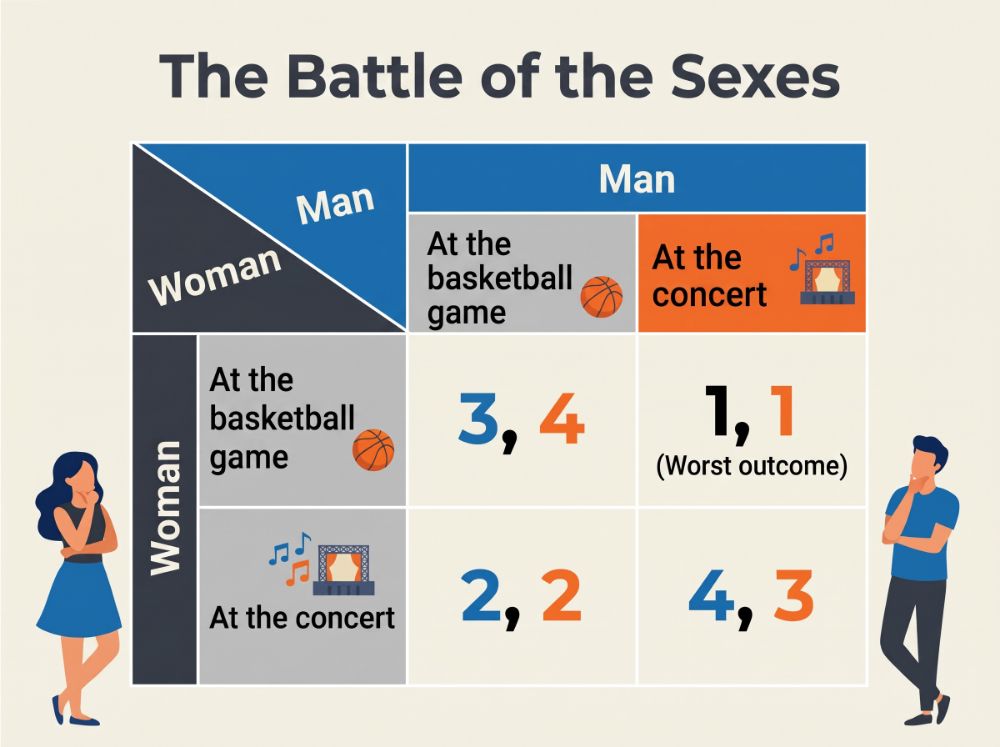
The golden rule ends up in what I call "do-goodism". Each acts for the other's good, and both end up at the place their partner wanted, but alone.
Kant's imperative, in its pure strategy (before adding a pinch of randomness), sends each one to the event they prefer. But on their own.
Once again chance comes to the rescue, with mixed strategies.
Each player rolls a d8: on 1 to 5 they go to the event they want, on 6 to 8 to their partner's.
Mathematics, or rationality if you like, takes back control and shows that this strategy is the best option.
One could object that it is a theoretical case, because it is hard to pin down a payoff matrix in such clear-cut terms.
The lesson to take home is that trying to please the other at all costs is toxic behaviour.
Mathematics says so, at least in this game.
Between rational and irrational
What we usually call a "rational choice" is tied to a calculation. I have inputs and boundary conditions that I take note of. With an almost algorithmic procedure I reach the best solution, which does not depend on who applied the procedure.
Moral Calculations insists that "rational choice" and "mathematical-deterministic choice" are not synonyms.
In praise of irrationality
As in the dollar auction, the rational choice is precisely the one that relies on "calculated randomness".
This "praise of irrationality" reaches its peak in chicken.
If your opponent had their hands tied, or were a drunk clown throwing whisky bottles out of the window, would you swerve?
I would not even start the car.
The last part of the book, perhaps the hardest, goes as far as presenting mysticism as a criterion for judgement and choice that is not to be dismissed next to what we usually call logic.
A not-so-easy essay
Moral Calculations is not an easy book. Mérő has encyclopaedic knowledge across many fields.
The book refers to Kant, economic models and quantum physics. Few readers can keep up with all of these topics.
Also, some concepts, such as Kant's categorical imperative, feel forced or abstract when placed in a game theory setting.
The many examples, quotations and theorems ask a lot of the reader. So the publisher was right to include an analytical index, which makes it easier to move between concepts.
It is not so much a book that teaches skills as one that, as on other occasions, invites debate and reflection.