L'equilibrio impossibile
Teoria dei giochi nel conflitto tra Stati Uniti e Iran
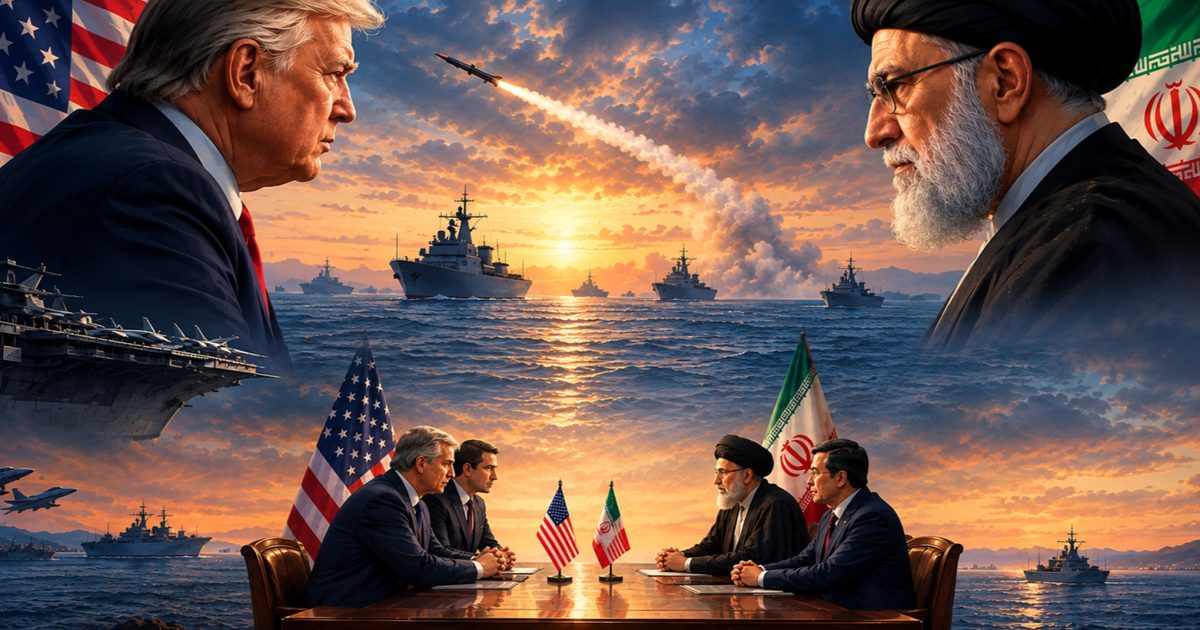
Dopo aver letto un post nel gruppo LudoStoria su un articolo di Cristina Bicchieri sul Sole 24 Ore, ho voluto analizzare nel dettaglio la situazione che proponeva con una matrice dei payoff.
Follia, copioni e teoria dei giochi
Il conflitto tra Stati Uniti e Iran non è guidato dalla follia. Le mosse degli attori sono razionali: rispondono in modo localmente ottimale alle proprie aspettative, ai vincoli interni e alla reputazione da difendere. Il cortocircuito avviene quando i classici meccanismi di reciprocità si rompono e l'interazione diventa un dilemma distruttivo.
Dalla deterrenza alla compellence
All'inizio la crisi seguiva il meccanismo del tit for tat (pan per focaccia): chi defeziona viene punito, chi torna a cooperare viene perdonato. L'uccisione della Guida Suprema ha cambiato questa struttura: non è stata una risposta proporzionata, ma un tentativo di chiudere la partita.
Questo evento segna il passaggio dalla deterrence (impedire un'azione) alla compellence (costringere l'avversario a un atto visibile di sottomissione), come l'ha teorizzata Thomas Schelling. Perché funzioni servono due promesse credibili allo stesso tempo: «se non cedi, colpisco» e «se cedi, sei al sicuro». L'eliminazione dei vertici rende reale la minaccia ma distrugge la promessa di sicurezza.
Matrici dei payoff: il crollo delle rassicurazioni
Per tradurre questa tesi in teoria dei giochi analizziamo due scenari con le matrici dei payoff. I valori vanno da 4 (esito migliore) a 0 (esito peggiore in assoluto) e sono indicati come (payoff USA, payoff Iran). Sono valori arbitrari, ovviamente: qui hanno solo valore illustrativo.
Scenario 1: compellence con rassicurazione intatta (il caso formale)
In questo modello il gioco è sequenziale: gli USA muovono per primi e decidono se mantenere la coercizione o ritirarsi; l'Iran risponde fidandosi della promessa americana. Se cede, il regime viene risparmiato, con un payoff di sopravvivenza pari a 2.
| USA \ Iran | Cede (sottomissione) | Resiste (escalation) |
|---|---|---|
| Mantiene la coercizione | (4, 2) | (1, 1) |
| Si ritira | (3, 3) | (2, 4) |
In verde l'equilibrio perfetto nei sottogiochi (induzione a ritroso).
Logica strategica (induzione a ritroso). Il gioco è sequenziale, quindi si risolve partendo dalla fine. Se gli USA scegliessero di ritirarsi, la risposta migliore dell'Iran sarebbe resistere (4 > 3), con esito (2, 4). Se invece gli USA mantenessero la coercizione, la risposta migliore dell'Iran sarebbe cedere (2 > 1), con esito (4, 2). Confrontando i due esiti dal punto di vista americano, (4, 2) domina (2, 4): gli USA mantengono la coercizione e l'Iran cede. L'esito (4, 2) è l'unico equilibrio perfetto nei sottogiochi, non una preferenza arbitraria per la casella evidenziata.
Scenario 2: il crollo della fiducia (lo stallo reale)
I precedenti storici (Gheddafi, lo stralcio dell'accordo del 2015) e l'uccisione dei suoi leader mostrano che nemmeno il rispetto formale degli accordi garantisce la sicurezza. Con queste premesse l'Iran percepisce che la resa porta all'annientamento: il payoff del cedere crolla a 0.
| USA \ Iran | Cede (sottomissione) | Resiste (escalation) |
|---|---|---|
| Mantiene la coercizione | (4, 0) | (1, 1) |
| Si ritira | (3, 3) | (2, 4) |
In verde la previsione formale, che non si realizza: per l'Iran resistere è la strategia dominante, quindi la risposta migliore degli USA è ritirarsi.
Logica strategica:
- L'Iran ha ora una strategia strettamente dominante: resistere. Qualunque cosa facciano gli USA, resistere (1 o 4) è sempre meglio che cedere (0 o 3).
- Sapendo che l'Iran resisterà sempre, l'unica scelta razionale degli USA per evitare la distruzione reciproca (1, 1) sarebbe ritirarsi (2, 4).
Il modello formale prevede quindi un esito chiaro: (si ritira, resiste) = (2, 4). Nella realtà questo esito non si verifica, perché i costi reputazionali e i vincoli delle fazioni interne, che la matrice non coglie, rendono il ritiro politicamente impraticabile per gli USA, anche se sulla carta è la mossa «razionale».
È qui che il modello si rompe: non perché generi un vero gioco del pollo (l'Iran non ha incertezza strategica, ha una strategia dominante), ma perché la mossa razionale prevista dal gioco è bloccata da vincoli esterni.
Il risultato è una trappola dell'escalation «fuori dal modello»: gli USA restano ancorati alla coercizione pur sapendo che porta a (1, 1), perché l'alternativa razionale (2, 4) è resa impraticabile da dinamiche di politica interna che un gioco a due non rappresenta. Ed è proprio questo scarto tra l'ottimo teorico e i vincoli politici reali a produrre lo stallo nello Stretto di Hormuz.
Il gioco non è a colpo singolo: la reputazione come vincolo formale (paradosso della catena di negozi)
Il limite dello Scenario 2 è trattare i «costi reputazionali» come una nota a margine, esterna al modello. Ma il confronto tra USA e Iran non è isolato: gli Stati Uniti giocano contemporaneamente partite simili con altri attori con cui hanno tensioni aperte (la Cina su Taiwan, la Corea del Nord, il Venezuela).
È esattamente la struttura del paradosso della catena di negozi (Chain Store Paradox; Selten, 1978, poi raffinato da Kreps e Wilson, 1982): un giocatore di lungo periodo (la catena di negozi, qui gli USA) affronta sfidanti diversi in mercati o teatri distinti. Cedere in un luogo, anche se localmente razionale, segnala a tutti gli sfidanti successivi che il giocatore di lungo periodo è «debole» e li incoraggia a lanciare la propria sfida. Mantenere una reputazione di durezza in un confronto ha quindi un valore che va oltre quello scontro.
Lo formalizziamo introducendo un costo reputazionale R, che gli USA pagano in ogni esito in cui scelgono di ritirarsi, qualunque sia la risposta iraniana, perché gli altri osservatori vedono l'atto del ritiro, non i dettagli del negoziato. Il costo si applica quindi a tutta la riga «si ritira» della matrice dello Scenario 2:
| USA \ Iran | Cede | Resiste |
|---|---|---|
| Mantiene la coercizione | (4, 0) | (1, 1) |
| Si ritira | (3 − R, 3) | (2 − R, 4) |
L'Iran mantiene comunque la resistenza come strategia dominante (i suoi payoff non cambiano). La domanda diventa: per quali valori di R la risposta ottimale degli USA alla resistenza smette di essere il ritiro? Confrontando le due opzioni americane quando l'Iran resiste, mantenere (1) contro ritirarsi (2 − R), la soglia è:
2 − R < 1 ⇔ R > 1
Con un valore concreto, R = 2 (il costo di credibilità supera il guadagno locale del disimpegno). Sposta il cursore per vedere come cambia l'equilibrio al variare di R:
| USA \ Iran | Cede | Resiste |
|---|---|---|
| Mantiene la coercizione | (4, 0) | (1, 1) |
| Si ritira | (1, 3) | (0, 4) |
In verde l'equilibrio per il valore di R scelto (con R = 2: mantiene la coercizione, resiste = (1, 1)). Con R = 1 gli USA sono indifferenti tra le due mosse.
A questo punto (si ritira, resiste) = (0, 4) non è più la risposta migliore degli USA: dato che l'Iran resiste comunque, mantenere (payoff 1) batte ritirarsi (payoff 0). (Mantiene la coercizione, resiste) = (1, 1) diventa l'unico equilibrio e sostituisce l'esito (2, 4) che nello Scenario 2 era «razionale sulla carta».
La reputazione verso più pubblici non è più un vincolo esterno non modellato: è il termine che sposta l'equilibrio stesso verso l'esito di distruzione reciproca. È il tratto distintivo del paradosso della catena di negozi, in cui restare «irrazionalmente» duri in una singola partita è la strategia ottimale di lungo periodo sull'insieme delle partite.
Limite da notare: qui la reputazione è formalizzata solo dal lato americano. Probabilmente l'Iran ha un incentivo simmetrico: cedere indebolirebbe la credibilità della sua rete di alleati armati (Hezbollah, Houthi, milizie irachene), che questo modello non coglie. Un'estensione naturale sarebbe un R analogo sui payoff iraniani nella colonna «cede», che renderebbe ancora più solida la strategia dominante della resistenza.
La soluzione a quattro giocatori
Un accordo vago tra due avversari senza fiducia reciproca rischia di degenerare: qualunque memorandum ambiguo tra parti che non si fidano più diventa terreno fertile per nuove escalation. Per sbloccare lo stallo la teoria dei giochi prescrive di introdurre garanti esterni, che ripristinino il payoff di sicurezza (il «2» dello Scenario 1):
| Giocatore | Ruolo teorico | Funzione nel negoziato |
|---|---|---|
| USA | Attore principale | Concedere un alleggerimento economico e militare progressivo. |
| Iran | Attore principale | Fermare le azioni asimmetriche e tornare agli standard precedenti alla crisi. |
| Garante degli USA | Garante | Condividere il peso politico per ridurre la percezione interna di una «resa» americana. |
| Garante dell'Iran | Garante (per esempio Cina o Russia) | Dare all'Iran una rassicurazione strutturale e garantire di assorbire le sanzioni se gli USA violano gli accordi. |
In un modello multilaterale la fiducia si ripone nei garanti, non nel nemico. Le guerre finiscono quando qualcuno riesce a cambiare le aspettative di tutti nello stesso momento. Trasformare un tavolo a due fallito in un equilibrio garantito a quattro è la condizione logica indispensabile per riuscirci.
Bibliografia
- Bicchieri, C. (s.d.). Così la teoria dei giochi ci spiega i sei mesi di guerra tra l'Iran e gli Stati Uniti. Il Sole 24 Ore, Scenari globali/1, Festival dei Sensi.
- Schelling, T. C. (1960). The Strategy of Conflict. Harvard University Press.
- Schelling, T. C. (1966). Arms and Influence. Yale University Press.
- Selten, R. (1978). The Chain Store Paradox. Theory and Decision, 9(2), 127–159.
- Kreps, D. M., & Wilson, R. (1982). Reputation and Imperfect Information. Journal of Economic Theory, 27(2), 253–279.
Prima pubblicazione: LinkedIn, 11 settembre 2026 (in inglese).
The Impossible Equilibrium
Game Theory in the US-Iran Conflict
After reading a post in the LudoStoria group about an article by Cristina Bicchieri in Il Sole 24 Ore, I wanted to analyze the situation she proposed in detail using a payoff matrix.
Madness, Scripts, and Game Theory
The conflict between the United States and Iran is not driven by madness. The actors' moves are rational: they respond in a locally optimal manner given their expectations, internal constraints, and reputations to defend. The short circuit occurs when the classic mechanisms of reciprocity break down, transforming the interaction into a destructive dilemma.
From Deterrence to Compellence
Initially, the crisis followed the tit for tat mechanism, where defection is punished and those who return to cooperation are forgiven. The assassination of the Supreme Leader altered this structure: it was not a proportional response, but an attempt to end the game.
This event marks the transition from deterrence (preventing an action) to compellence (forcing the adversary into a visible act of submission), as theorized by Thomas Schelling. For it to work, two simultaneously credible promises are required: "if you do not yield, I will strike" and "if you yield, you are safe." The elimination of top leaders makes the threat real but destroys the promise of safety.
Payoff Matrices: The Collapse of Reassurance
To translate this thesis into game theory, we analyze two scenarios through payoff matrices, where values range from 4 (optimal outcome) to 0 (absolute worst outcome), indicated as (US Payoff, Iran Payoff). These values are arbitrary, of course. Here they have only illustrative value.
Scenario 1: Compellence with intact reassurance (the formal case)
In this model, the game is sequential: the US moves first, deciding whether to maintain coercion or stand down, and Iran responds accordingly, trusting the American promise — if it yields, the regime is spared, with a survival payoff of 2.
| US \ Iran | Yield (submission) | Resist (escalation) |
|---|---|---|
| Maintain coercion | (4, 2) | (1, 1) |
| Stand down | (3, 3) | (2, 4) |
Highlighted in green: the subgame perfect equilibrium (backward induction).
Strategic rationale (backward induction): since the game is sequential, it is solved backwards. If the US chose to Stand Down, Iran's best response would be to Resist (4 > 3), leading to (2, 4). If instead the US chose to Maintain Coercion, Iran's best response would be to Yield (2 > 1), leading to (4, 2). Comparing the two outcomes from the US perspective, (4, 2) dominates (2, 4): the US therefore chooses to Maintain Coercion, and Iran responds by Yielding. The outcome (4, 2) is the unique subgame perfect equilibrium — not an arbitrary preference for the highlighted cell.
Scenario 2: The collapse of trust (the actual stalemate)
Historical precedents (Gaddafi, the scrapping of the 2015 agreement) and the assassination of its leaders demonstrate that not even formal compliance with agreements guarantees safety. Under these assumptions, Iran perceives that surrender leads to annihilation: the payoff for Yielding plummets to 0.
| US \ Iran | Yield (submission) | Resist (escalation) |
|---|---|---|
| Maintain coercion | (4, 0) | (1, 1) |
| Stand down | (3, 3) | (2, 4) |
Highlighted in green: the formal (unrealized) prediction. Iran's dominant strategy is Resist, so the US best response is Stand Down.
Strategic rationale:
- Iran now has a strictly dominant strategy: Resist. Regardless of US moves, resisting (1 or 4) is always superior to yielding (0 or 3).
- Knowing that Iran will always choose to Resist, the only rational choice for the US to avoid mutual destruction (1, 1) would be to Stand Down (2, 4).
The formal model thus predicts a clear outcome: (Stand Down, Resist) = (2, 4). In reality, this outcome does not materialize because reputational costs and internal factional constraints — factors the matrix does not capture — make Standing Down politically unfeasible for the US, even if it is the "rational" move on paper.
This is where the model breaks down: not because it generates a true game of chicken (Iran has no strategic uncertainty; it has a dominant strategy), but because the rational move predicted by the game is blocked by external constraints.
The result is an "out-of-model" escalation trap: the US remains anchored to Maintain Coercion despite knowing it leads to (1, 1), because the rational alternative (2, 4) is rendered unworkable by domestic political dynamics that a two-player game does not represent — and it is precisely this gap between the theoretical optimum and actual political constraints that produces the stalemate in the Strait of Hormuz.
The Game Is Not One-Shot: Reputation as a Formal Constraint (Chain Store Paradox)
The limitation of Scenario 2 is treating "reputational costs" as a footnote, external to the model. But the US-Iran confrontation is not isolated: the United States is simultaneously playing similar games with other actors with whom it has open tensions (China over Taiwan, North Korea, Venezuela).
This is exactly the structure of the Chain Store Paradox (Selten, 1978; refined by Kreps and Wilson, 1982): a long-run player — the chain store, or here the US — faces different challengers in distinct markets or theaters. Yielding (accommodating) in one venue, even if locally rational, signals to all subsequent challengers that the long-run player is "weak," encouraging them to issue their own challenges. Maintaining a reputation for toughness in one confrontation therefore has a value that extends beyond that specific clash.
We formalize this by introducing a reputational cost R, which the US incurs in any outcome where it chooses to Stand Down — regardless of the Iranian response, because other audiences observe the act of retreating, not the details of the negotiation. The cost thus applies to the entire Stand Down row of the Scenario 2 matrix:
| US \ Iran | Yield | Resist |
|---|---|---|
| Maintain coercion | (4, 0) | (1, 1) |
| Stand down | (3 − R, 3) | (2 − R, 4) |
Iran maintains Resist as a dominant strategy in any case (its payoffs do not change). The question becomes: for what values of R does the optimal US response to Resisting cease to be Standing Down? Comparing the two US options given Iranian Resistance — Maintain (1) versus Stand Down (2 − R) — the threshold is:
2 − R < 1 ⇔ R > 1
With a concrete value, R = 2 (the credibility cost exceeds the local gain of disengagement). Move the slider to see how the equilibrium changes with R:
| US \ Iran | Yield | Resist |
|---|---|---|
| Maintain coercion | (4, 0) | (1, 1) |
| Stand down | (1, 3) | (0, 4) |
Highlighted in green: the equilibrium for the chosen R (with R = 2, (Maintain Coercion, Resist) = (1, 1)). At R = 1 the US is indifferent between the two moves.
At this point, (Stand Down, Resist) = (0, 4) is no longer the best US response: since Iran resists anyway, Maintaining (payoff 1) beats Standing Down (payoff 0). (Maintain Coercion, Resist) = (1, 1) becomes the unique equilibrium, replacing the (2, 4) outcome that in Scenario 2 was identified as "rational on paper."
Multi-audience reputation is no longer an unmodeled external constraint: it is the term that shifts the equilibrium itself toward the mutually destructive outcome — the hallmark of the Chain Store Paradox, where remaining "irrationally" tough in a single game is the optimal long-run strategy across all games combined.
Limitation to note: reputation is formalized here only on the US side. Iran likely has a symmetrical incentive — yielding would weaken the credibility of its proxy network (Hezbollah, Houthis, Iraqi militias) — which this model does not capture. A natural extension would be an analogous R on the Iranian payoffs in the Yield column, which would make the dominant strategy of Resisting even more robust.
The Four-Player Solution
A vague agreement between two adversaries lacking mutual trust risks degenerating: any ambiguous memorandum between parties who no longer trust each other becomes fertile ground for new escalations. To break the deadlock, game theory prescribes the introduction of external guarantors to restore the safety payoff (the "2" in Scenario 1):
| Player | Theoretical role | Function in negotiation |
|---|---|---|
| US | Primary actor | Concede progressive economic/military relief. |
| Iran | Primary actor | Halt asymmetric actions and return to pre-crisis standards. |
| US guarantor | Enforcer | Share the political burden to minimize the domestic perception of US "surrender." |
| Iran guarantor | Enforcer (e.g., China/Russia) | Provide structural reassurance to Iran and guarantee the absorption of sanctions if the US violates the agreements. |
In a multilateral model, trust is placed in the enforcers, not in the enemy. Wars end when someone manages to change everyone's expectations at the same time. Transforming a failed two-player table into a guaranteed four-player equilibrium is the indispensable logical condition for achieving this goal.
Bibliography
- Bicchieri, C. (n.d.). Così la teoria dei giochi ci spiega i sei mesi di guerra tra l'Iran e gli Stati Uniti. Il Sole 24 Ore, Scenari globali/1, Festival dei Sensi.
- Schelling, T. C. (1960). The Strategy of Conflict. Harvard University Press.
- Schelling, T. C. (1966). Arms and Influence. Yale University Press.
- Selten, R. (1978). The Chain Store Paradox. Theory and Decision, 9(2), 127–159.
- Kreps, D. M., & Wilson, R. (1982). Reputation and Imperfect Information. Journal of Economic Theory, 27(2), 253–279.
First published on LinkedIn, September 11, 2026.